Life science product and service companies are usually excellent at explaining what they do. They’re far less good at articulating why it matters. Here, our Head of Creative Lauren Gray shows how to close that gap and shift from leaving your audience thinking “Good for you…” to “That’s great for me!”
We’ve worked with a lot of life science product and service providers over the years, from CROs and consultancies to instrument and reagent manufacturers, software companies and more. And across almost all of them, we see the same pattern.
They’re very good at explaining what they do. They’re much less good at explaining why it matters.
The result is websites and marketing materials that read like technical catalogues. Long feature lists. Platform capability descriptions. Service pages that name every offering, but never quite connect with the person reading them.
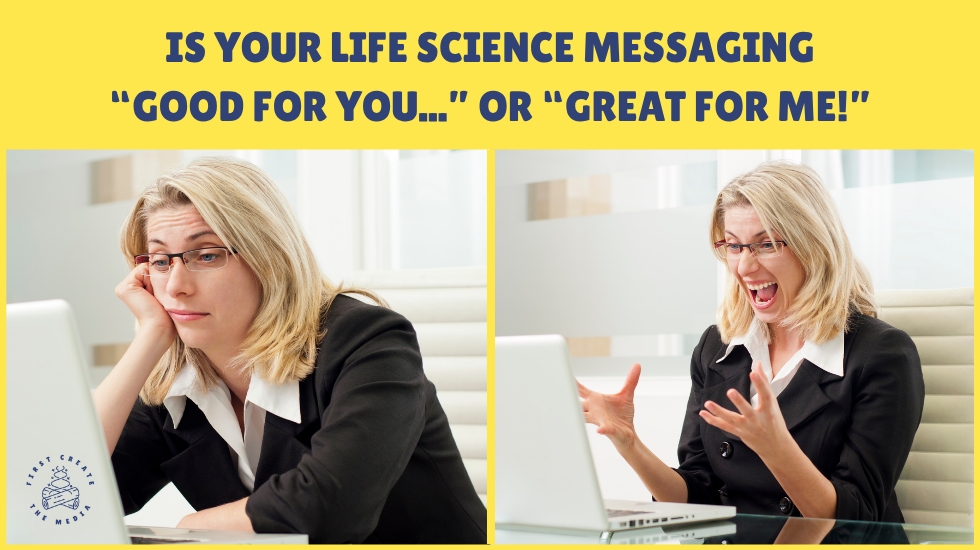
The reaction they tend to get? “That’s nice. Good for you…”
The reaction they want? “Oh, that’s great for me!”
It’s a small shift, but it reflects an enormous difference in how the messaging lands, and how your customers respond. Here’s how to spot the problem and – more importantly – how to fix it.
What life science company websites get wrong
There are very good structural reasons why life science companies tend to communicate in a technical, feature-led way.
First, there’s the practical reality. Many of these businesses were founded by scientists and engineers who are, quite rightly, proud of what they’ve built.
Technology that took many painstaking years to perfect. Products and tools that outperform the competition by a country mile. Expertise and knowledge accumulated over decades. The natural inclination is to get as much detail out there as possible to show the full breadth of what’s on offer.
There’s also an emotional dimension to this approach.
Technical specifications feel safe. They’re objective, defensible, precise. Whereas talking about customer problems – the confusion, the wasted time, the failed experiments, the deadline pressures – can feel uncomfortable and vulnerable. We’re all scientists, so let’s just stick to the data and have none of that squishy feelings stuff…
Finally, there’s an organisational issue. In many life science companies, marketing teams are experts in marketing (the clue’s in the name), but might not have strong creative science writing skills. Instead, they rely on their scientific colleagues to generate science-led marketing content, which naturally ends up mirroring their technical language and mindset.
All of these are a manifestation of feature-led communication, when what your customer audience needs is problem-led communication. That distinction matters more than most companies realise.
Why feature-led life science marketing misses the mark
When your messaging is built around features, a few things happen. (Spoiler: none of them are good).
First, there’s the missed opportunity for connection. When potential customers can’t see themselves in your story, they’re less likely to look further. If they read a list of capabilities and have to do the mental work of figuring out whether any of it applies to their situation, most won’t bother.
Differentiation also disappears. Features alone rarely tell anyone why you, specifically, are the right choice. Without a clear connection to the specific problems your customers face, you end up sounding like every other provider in the space – it’s hard to stand out from the crowd if everyone is describing their technology in similar terms.
Worst of all, it’s just so boring.
Product specs and service lists that make your product seem like a thrilling proposition to the people who built it aren’t always so engaging to the buyers they’re meant to reach. As a result, marketing assets languish unread in conference tote bags or email inboxes, while the website starts to look more like internal documentation than an enticing shop-front.
This is especially true for top-of-funnel marketing stages, where the aim is to capture attention and encourage deeper engagement. And, if we’re being honest, there’s plenty of bottom-of-funnel material that could do with being less dull, too.
To fix boring life science messaging, move from features to feelings
When messaging is built around problems and feelings rather than features, everything shifts.
Relevance becomes obvious. Credibility becomes meaningful because it’s demonstrated in the context of real challenges, not a list of buzzwords. And the right customers self-select in, rather than bouncing away.
The framework we use when working with clients on this challenge is simple: we call it feature to feeling.
The idea is to translate what a product or service does into what it actually means for the person using it. We start by asking three questions in sequence:
| FEATURE | What does the product, service or specific feature do? For example, ‘high fidelity long read DNA sequencing’, ‘regulatory advice for early stage biotech companies’, ‘AI-enabled antibody design’, ‘picomolar sensitivity biomarker detection’… |
| SO WHAT? | What does it really do? What insight does it reveal? What critical issue does it prevent? What problem does it solve? What does it change about the customer’s day, project, results or even job? Keep asking until you hit something real. |
| FEELING | How does the customer’s situation actually improve? What gets easier, faster, more reliable, less frustrating? And how does it feel to achieve it? That’s what you need to engineer into your message. |
To make it concrete, here’s the kind of transformation we’re talking about:
| FEATURE
“High-throughput multiomic analysis platform with integrated proteomics and transcriptomics modules.” |
FEELING
“Finally integrate your proteomics and transcriptomics data without spending weeks wrestling with incompatible datasets.” |
Both versions describe the same product. But only one of them describes a recognisable problem and creates a moment of “Yes, that’s exactly what I’m dealing with!”
We’ve worked through this kind of translation with companies at very different stages, helping them move from technically accurate but unengaging copy to messaging that clearly reflects their audience’s day-to-day reality.
In one case, a company had buried their most compelling differentiator in a footnote of a services page. Once that moved to the centre of the messaging, the value of their innovation became obvious, and their solution much harder to ignore.
The same thinking translates well beyond the website, too.
Problem-led messaging is more compelling in email, more shareable on LinkedIn, and easier to turn into content. That’s because it starts with something the audience already cares about – their own problems and emotional state – rather than something you have to convince them of.
Test your life science messaging: is it feature-led or feeling-led?
If you want a fast way to assess where your own messaging sits, try this.
Imagine someone landing on your homepage with no prior knowledge of your company. Within a few seconds, can they clearly answer these four questions?
- Is this relevant to my problem?
- Does this company understand my world?
- Have they solved this kind of problem before?
- Why should I believe them?
If those answers aren’t obvious within a few seconds – not buried in a case study or implied by a product description, but actually visible up front on the page – then it’s likely that your messaging is too focused on yourself, and too little on your reader.
None of this means stripping out technical content. Life science buyers are sophisticated. They want to understand what they’re buying and they will scrutinise the details. It’s not about replacing rigour with fluff – it’s about leading with relevance so that when they dig deeper the technical detail lands in the right context.
The goal of marketing for life science product and service companies isn’t simply to explain what you do. It’s to make it clear why that matters to the people who need it.
When that shift happens, the reaction changes from “Good for you…” to “Great for me!”
That’s the difference between marketing that merely describes and marketing that actually persuades.
Need help going from feature to feeling with your life science marketing?
At First Create The Media we work with innovative life science product and service companies in the UK, Europe and the US, helping them refine their story and messaging, showcase their credibility, and stand out from the crowd.
If you suspect your website is stuck in “Good for you” mode, it may be time to make the move from features to feelings. We’re always happy to take a look and help you translate complex science into messaging that actually resonates with your audience.